Cryptocurrency Investing for Beginners: Complete 2026 Guide
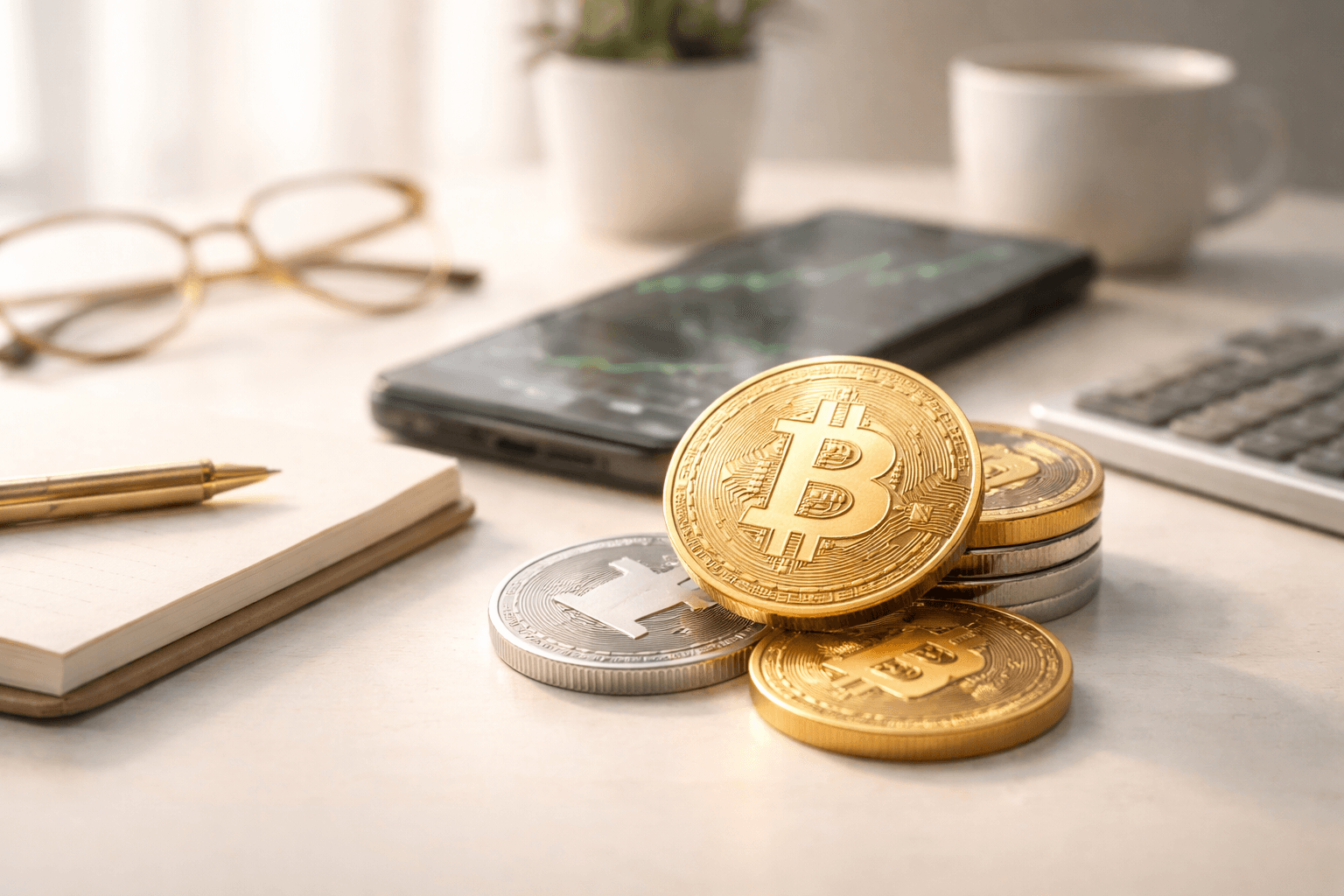
Your Complete Guide to Getting Started with Crypto
Cryptocurrency has gone mainstream. With over 560 million people now owning crypto and the total market cap surpassing $4 trillion in 2025, digital assets have become a legitimate part of the investment landscape. But for newcomers, the crypto world can feel overwhelming with its unfamiliar terminology, volatile prices, and countless options.
This guide breaks down everything you need to know to start investing in cryptocurrency safely and intelligently in 2026.
What You'll Learn
- What cryptocurrency is and how it works
- How to choose and set up your first exchange account
- Best practices for buying Bitcoin, Ethereum, and other cryptocurrencies
- How to secure your investments properly
- Common mistakes to avoid as a beginner
- New 2026 tax reporting requirements you need to know
What Is Cryptocurrency?
Cryptocurrency is a type of digital money that runs on technology called blockchain. Unlike traditional currencies controlled by banks or governments, crypto operates on a decentralized network of computers. This blockchain technology keeps a record of all transactions, shared across thousands of computers, so no single person or institution controls it.
Key Concepts to Understand
- Blockchain: A public, distributed ledger that records all transactions permanently and transparently
- Decentralization: No central authority controls the network; it's maintained by participants worldwide
- Private Keys: Secret codes that prove ownership of your crypto (like a password you must never lose)
- Wallets: Software or hardware that stores your private keys and lets you send/receive crypto
- Mining/Staking: Methods used to validate transactions and secure the network
The Major Cryptocurrencies
While thousands of cryptocurrencies exist, beginners should focus on established options:
- Bitcoin (BTC): The original cryptocurrency, often called "digital gold." Best for long-term store of value.
- Ethereum (ETH): The second-largest crypto, powers smart contracts and decentralized applications.
- Stablecoins (USDC, USDT): Cryptocurrencies pegged to the US dollar, useful for trading and earning yield.
Beginner's Rule
Stick to well-known cryptocurrencies like Bitcoin and Ethereum when starting out. They have the longest track records, largest communities, and most available information. Avoid obscure altcoins until you have more experience.
Step 1: Choose a Cryptocurrency Exchange
An exchange is a platform where you can buy, sell, and trade cryptocurrencies. Choosing the right one is critical for beginners.
Best Exchanges for Beginners in 2026
Coinbase is widely considered the best starting point for complete beginners:
- Extremely user-friendly interface requiring minimal technical knowledge
- Supports 250+ cryptocurrencies
- "Learn and Earn" program lets you earn free crypto while learning
- Strong regulatory compliance in the US
- Fees: 0.40%/0.60% maker/taker
Kraken is ideal for beginners who want lower fees and plan to grow:
- Supports 400+ cryptocurrencies
- Lower fees than Coinbase (0.25%/0.40% maker/taker)
- Institutional-grade security record
- Both beginner and advanced trading interfaces
- Not available in NY or Maine
Gemini offers a security-focused option:
- Founded by the Winklevoss twins
- Strong regulatory compliance
- Clean, simple interface
- Higher fees but excellent security
What to Look for in an Exchange
- Ease of use: Clean interface, simple buying process
- Security: Two-factor authentication, cold storage, insurance
- Fees: Compare trading fees, deposit/withdrawal fees
- Supported assets: Make sure it lists the cryptos you want
- Reputation: Established track record, regulatory compliance
Step 2: Set Up Your Account Securely
Once you've chosen an exchange, follow these steps to set up your account properly.
Account Creation Checklist
- Use a strong, unique password (at least 16 characters, mix of letters, numbers, symbols)
- Enable two-factor authentication (2FA) immediately using an authenticator app (not SMS)
- Complete identity verification (KYC) with valid ID and proof of address
- Secure your email account with 2FA as well (it's the gateway to password resets)
- Write down your recovery codes and store them offline in a safe place
Security Warning
Never share your password, 2FA codes, or recovery phrases with anyone. Legitimate exchanges will never ask for these. Scammers often impersonate support staff to steal credentials.
Step 3: Fund Your Account and Make Your First Purchase
Adding Funds
Most exchanges accept:
- Bank transfer (ACH): Free or low fee, takes 1-5 business days
- Wire transfer: Faster but higher fees ($10-30)
- Debit card: Instant but higher fees (2-4%)
- Credit card: Often blocked by card issuers, highest fees
For beginners, bank transfer is usually the best balance of cost and convenience.
Making Your First Purchase
- Navigate to the "Buy" or "Trade" section
- Select the cryptocurrency you want (start with Bitcoin or Ethereum)
- Enter the amount in your local currency (you can buy fractions)
- Review the total including fees
- Confirm the purchase
How Much Should You Invest?
The Golden Rule
Only invest money you can afford to lose completely. Cryptocurrency is highly volatile and should be a supplement to your portfolio, not a core holding. Most financial advisors suggest limiting crypto to 5-10% of your total investment portfolio.
Step 4: Develop an Investment Strategy
Dollar-Cost Averaging (DCA)
The best strategy for beginners is dollar-cost averaging: invest a fixed amount on a regular schedule regardless of price.
Example: Instead of investing $1,200 all at once, invest $100 every month for a year.
Benefits:
- Reduces the impact of volatility
- Removes emotional decision-making
- No need to "time the market"
- Builds discipline and habit
HODL Strategy
"HODL" (Hold On for Dear Life) means buying and holding for the long term without trying to trade short-term price movements. This works well for:
- Beginners who don't have time to actively trade
- Those who believe in crypto's long-term potential
- Investors who want to minimize fees and taxes
What NOT to Do
- Don't try to time the market
- Don't invest based on social media hype
- Don't use leverage or margin trading as a beginner
- Don't invest more than you can afford to lose
- Don't panic sell during dips
Step 5: Secure Your Cryptocurrency
Exchanges are convenient but not hack-proof. Major platforms including Binance have suffered security breaches. For significant holdings, you need proper security.
Types of Wallets
Hot Wallets (Software):
- Connected to the internet
- Convenient for frequent transactions
- Free to use
- Higher risk of hacking
- Examples: MetaMask, Trust Wallet, exchange wallets
Cold Wallets (Hardware):
- Offline storage devices
- Most secure option for long-term storage
- Cost $50-$250
- Ideal for significant holdings
- Examples: Ledger, Trezor
Best Hardware Wallets for Beginners
Ledger Nano S Plus ($79):
- Best overall for beginners
- Secure Element chip (bank-grade security)
- Supports 5,500+ cryptocurrencies
- Easy-to-use Ledger Live app
- Compact design
Trezor Model One ($59):
- Most affordable option
- 100% open-source software
- Simple, proven security since 2014
- Great entry point for cold storage
Trezor Model T ($169):
- Touchscreen for easier use
- Premium features
- Excellent for those who want convenience
Security Best Practices
- Keep small amounts on exchanges for trading, move the rest to cold storage
- Never share your seed phrase (12-24 words) with anyone
- Store seed phrase offline in multiple secure locations
- Use unique passwords for every crypto-related account
- Be wary of phishing - always verify URLs and never click email links
Common Mistakes to Avoid
Beginner Pitfalls
1. Investing Without Research (DYOR) Never buy a cryptocurrency just because someone on social media recommended it. Understand what you're investing in first.
2. FOMO (Fear of Missing Out) Buying when prices are surging because you're afraid to miss gains typically leads to buying high and selling low.
3. Putting All Eggs in One Basket Don't invest everything in a single cryptocurrency. Diversify across at least 2-3 established projects.
4. Panic Selling Crypto is volatile. Selling during every dip locks in losses. If you believe in your investments, hold through volatility.
5. Ignoring Fees Trading fees, network fees, and withdrawal fees add up quickly. Factor them into your strategy.
6. Overtrading Constant buying and selling generates fees and taxes while rarely outperforming simple buy-and-hold strategies.
7. Using Leverage Too Early Margin trading can multiply losses. Beginners should avoid leverage entirely until they have significant experience.
8. Poor Security Using weak passwords, skipping 2FA, or leaving large amounts on exchanges can lead to permanent loss.
Understanding Crypto Taxes in 2026
New CARF Reporting Requirements
As of January 1, 2026, the Crypto-Asset Reporting Framework (CARF) went into effect across 48 countries including the UK and EU. This is a major change for crypto investors:
- Exchanges must report: Your identity, tax residency, transaction history, and profits/losses
- Automatic data sharing: Tax authorities will share information across borders starting in 2027
- Applies broadly: Centralized exchanges, some DEXs, crypto ATMs, and brokers
What This Means for You
- No hiding from taxes: Authorities will know about your crypto activity
- Keep good records: Track your purchases, sales, and the cost basis for each transaction
- Report accurately: Penalties for non-compliance can be severe (up to 100% of taxes owed plus interest)
Tax Basics (US)
- Buying crypto: Not a taxable event
- Selling crypto: Taxable - capital gains/losses based on your cost basis
- Trading crypto for crypto: Taxable event
- Receiving crypto as payment: Taxed as income
- Holding over 1 year: Qualifies for lower long-term capital gains rates
Tax Tip
Use crypto tax software like Koinly, CoinTracker, or TaxBit to automatically track your transactions and generate tax reports. This is especially important given the new CARF reporting requirements.
Advanced Tips for When You're Ready
Level Up Your Crypto Knowledge
Learn About DeFi Decentralized Finance lets you earn yield, borrow, and trade without intermediaries. Start with established platforms like Aave or Lido.
Understand Staking Earn passive income by staking proof-of-stake cryptocurrencies like Ethereum. Many exchanges offer easy staking options.
Explore Layer 2s Networks like Arbitrum and Base offer faster, cheaper transactions while maintaining Ethereum's security.
Use a Portfolio Tracker Apps like CoinGecko, Delta, or your exchange's built-in tracker help you monitor performance across wallets and exchanges.
Recommended Tools for Beginners
Here are essential tools to support your crypto journey:
- TradingView: Best-in-class charting platform with crypto support
- CoinGecko/CoinMarketCap: Track prices, market caps, and research projects
- Koinly: Crypto tax software that integrates with all major exchanges
- Ledger/Trezor: Hardware wallets for secure storage
Conclusion
Cryptocurrency investing doesn't have to be complicated. By following this guide, you can:
- Start with established exchanges like Coinbase or Kraken
- Focus on major cryptocurrencies like Bitcoin and Ethereum initially
- Use dollar-cost averaging to reduce timing risk
- Secure your holdings with proper wallet management
- Avoid common mistakes like FOMO buying and panic selling
- Stay compliant with new 2026 tax reporting requirements
Remember: crypto is volatile, and you should only invest what you can afford to lose. Start small, learn continuously, and gradually build your knowledge and position over time.
Frequently Asked Questions
How much money do I need to start investing in crypto?
You can start with as little as $10 on most exchanges. Bitcoin and other cryptocurrencies are divisible into tiny fractions, so you don't need to buy a whole coin.
Is cryptocurrency a good investment for beginners?
Cryptocurrency can be part of a diversified portfolio, but it's high-risk due to volatility. Beginners should start small, stick to established coins like Bitcoin and Ethereum, and never invest more than they can afford to lose.
What's the safest cryptocurrency to invest in?
Bitcoin is generally considered the "safest" cryptocurrency due to its longest track record, largest market cap, and widest adoption. Ethereum is the second most established option. However, no cryptocurrency is truly "safe" - all carry significant risk.
Should I use Coinbase or Kraken as a beginner?
Coinbase is better for complete beginners due to its simpler interface and educational resources. Kraken offers lower fees and more features, making it better for beginners who plan to become more active traders.
How do I avoid losing money in crypto?
Use dollar-cost averaging instead of investing lump sums, only invest money you can afford to lose, stick to established cryptocurrencies, avoid leverage, don't panic sell during dips, and secure your holdings properly with hardware wallets for larger amounts.
Do I have to pay taxes on cryptocurrency?
Yes, in most countries cryptocurrency gains are taxable. With the new CARF framework starting in 2026, exchanges now report your activity to tax authorities. Keep detailed records of all transactions and consider using crypto tax software.
What's the difference between a hot wallet and cold wallet?
Hot wallets are software-based and connected to the internet (convenient but less secure). Cold wallets are hardware devices that store your crypto offline (more secure but less convenient). Use hot wallets for small amounts you trade frequently, cold wallets for long-term storage of larger amounts.
Further Reading
Ready to continue your investment journey? Check out these related resources:
- TradingView Review - The most popular charting platform for crypto traders, with real-time data and technical analysis tools.
- Best Investing Courses - Expand your knowledge with our curated list of top-rated investing courses.
- M1 Finance Review - A modern brokerage platform that combines automated investing with customizable portfolios.
Disclaimer: This article is for informational purposes only and does not constitute financial advice, investment recommendations, or an endorsement of any particular security or strategy. Always conduct your own research and consult with a qualified financial advisor before making investment decisions. Past performance is not indicative of future results.
Enjoying this article? Get more like it.
No spam, unsubscribe anytime.
Written by
John SmithJohn is a financial analyst and investing educator with over 10 years of experience in the markets.