Stablecoins Explained: USDT, USDC, and DAI Compared
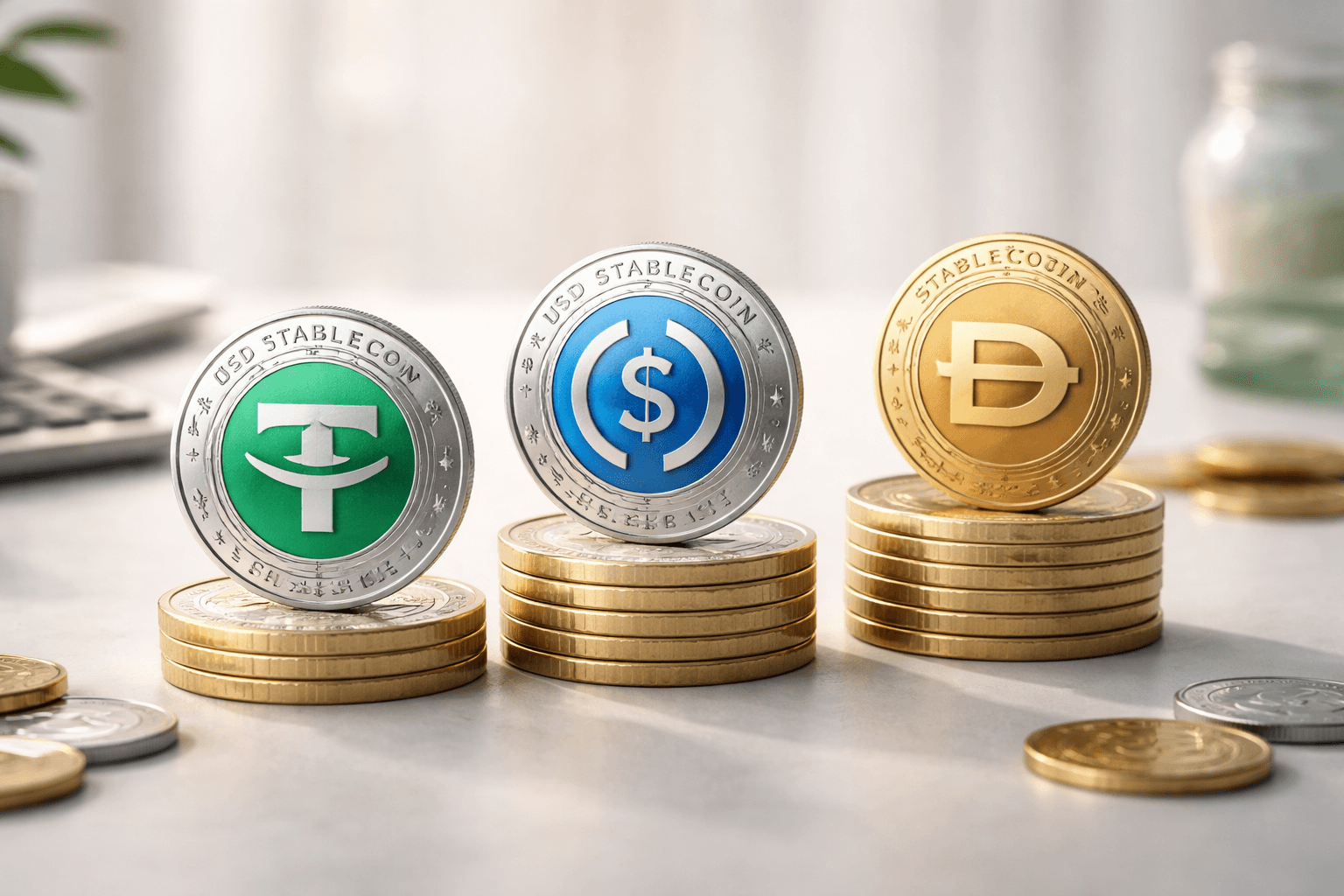
Stablecoins have become essential infrastructure in the cryptocurrency ecosystem. Unlike Bitcoin or Ethereum, which can swing 10% or more in a single day, stablecoins are designed to maintain a consistent value—typically pegged to $1 USD.
But not all stablecoins are created equal. The three dominant options—USDT (Tether), USDC (Circle), and DAI (MakerDAO)—each take fundamentally different approaches to maintaining their peg. Understanding these differences is crucial for any crypto investor.
Quick Comparison
USDT: Largest by market cap ($150B+), best for trading liquidity, some transparency concerns
USDC: Most transparent and regulated, strong institutional backing, ideal for compliance-focused users
DAI: Decentralized and censorship-resistant, crypto-backed, best for DeFi applications
What Are Stablecoins?
A stablecoin is a cryptocurrency designed to maintain a stable value relative to a reference asset—usually the US dollar. While Bitcoin's price fluctuates based on market speculation, stablecoins aim to always be worth approximately $1.
Stablecoins achieve this stability through different mechanisms:
- Fiat-backed: Reserves of dollars (or equivalent assets) held by a company
- Crypto-backed: Overcollateralized cryptocurrency locked in smart contracts
- Algorithmic: Supply-and-demand balancing through code (largely discredited after the Terra/UST collapse)
As of 2025, the stablecoin market exceeds $230 billion in total market capitalization, with projections suggesting multi-trillion dollar growth by 2030.
Why Use Stablecoins?
Stablecoins serve several critical functions:
- Trading: Quickly move between volatile assets without converting to fiat
- Yield earning: Deposit stablecoins to earn interest through lending protocols
- Payments: Send value globally without bank intermediaries or currency volatility
- Safe haven: Park funds during market downturns without leaving the crypto ecosystem
- DeFi access: Participate in decentralized finance protocols
USDT (Tether): The Market Leader
Tether (USDT) is the oldest and largest stablecoin, commanding approximately 61% of the total stablecoin market with over $150 billion in circulation as of 2025.
How USDT Works
USDT is a fiat-backed stablecoin issued by Tether Ltd. For each USDT token in circulation, Tether claims to hold $1 worth of reserves. These reserves include cash, cash equivalents, short-term deposits, commercial paper, and other assets.
USDT Strengths
Unmatched liquidity: USDT is accepted on virtually every exchange and has the deepest trading pairs. When you need to execute large trades quickly, USDT is often the best option.
Network availability: USDT operates on multiple blockchains including Ethereum, Tron, Solana, and many others, offering flexibility in transaction costs and speeds.
First-mover advantage: Years of market presence have made USDT the default stablecoin for many traders and platforms.
USDT Concerns
Transparency questions: Tether has faced ongoing scrutiny regarding the composition of its reserves. While the company provides quarterly attestations, critics note these aren't full audits.
Regulatory uncertainty: Tether has faced legal challenges and fines, and its exact reserve composition has been questioned by regulators.
Centralization risks: As a company-issued token, USDT can be frozen or blacklisted at specific addresses.
Pros
- Largest market cap and deepest liquidity
- Available on nearly every exchange and blockchain
- Proven track record since 2014
- Lowest slippage for large trades
- Wide DeFi integration
Cons
- Less transparent reserve attestations
- Regulatory concerns and past legal issues
- Centralized issuer can freeze funds
- Reserve composition includes non-cash assets
USDC (Circle): The Compliance Champion
USD Coin (USDC) is issued by Circle, a regulated financial technology company. With approximately $60 billion in circulation, USDC prioritizes transparency and regulatory compliance.
How USDC Works
Every USDC token is backed 1:1 by reserves held in segregated accounts. As of early 2025, USDC is actually slightly overcollateralized—$56.2 billion in reserves backing $56 billion in circulation.
Reserves consist of:
- Cash held at partner banks (~12%)
- Short-term US Treasury securities (~88%)
USDC Strengths
Transparency: Circle provides regular, detailed attestations from major accounting firms. Reserve composition is clearly disclosed.
Regulatory alignment: Circle is licensed as a money transmitter and complies with US regulations, making USDC attractive for institutions and regulated businesses.
Conservative reserves: The vast majority of reserves are in US Treasuries—among the safest assets in the world.
USDC Concerns
Bank dependency: When Silicon Valley Bank collapsed in March 2023, USDC briefly depegged because some reserves were held there. This highlighted counterparty risk.
Centralization: Like USDT, Circle can freeze addresses when required by law enforcement.
Lower liquidity: While substantial, USDC's trading volume and pairs are smaller than USDT's.
Pros
- Most transparent reserve reporting
- Regulatory compliance and institutional trust
- Conservative Treasury-backed reserves
- Slightly overcollateralized
- Strong reputation among US institutions
Cons
- Lower liquidity than USDT
- Bank counterparty risk (SVB incident)
- Centralized issuer can freeze funds
- Some DeFi protocols have less USDC integration
DAI: The Decentralized Alternative
DAI is a decentralized stablecoin created by MakerDAO, one of the oldest DeFi protocols. With approximately $3.7 billion in circulation, DAI takes a fundamentally different approach than its centralized competitors.
How DAI Works
DAI is crypto-backed rather than fiat-backed. Users deposit collateral (ETH, USDC, and other approved assets) into smart contracts called Vaults. They can then borrow DAI against this collateral.
The system requires overcollateralization—typically 150% or more. If collateral value drops too low, it's automatically liquidated to protect the system. This mechanism maintains DAI's peg without requiring trust in any company.
DAI Strengths
True decentralization: No company can freeze your DAI. The protocol is governed by MKR token holders through on-chain voting.
Transparency: All collateral is visible on the blockchain. Anyone can verify the system's health at any time.
Censorship resistance: DAI can't be blacklisted or seized by any central authority.
Dai Savings Rate (DSR): Users can earn yield simply by depositing DAI into the DSR contract—no lending platform required.
DAI Concerns
Complexity: Understanding how DAI maintains its peg requires knowledge of collateral ratios, liquidations, and governance.
Collateral composition: Ironically, a significant portion of DAI's collateral is USDC, making it partially dependent on centralized stablecoins.
Lower liquidity: DAI's market cap is roughly 2.5% of USDT's, meaning less trading depth.
Pros
- Truly decentralized and censorship-resistant
- Fully transparent on-chain collateral
- No single point of failure or trust required
- Dai Savings Rate offers passive yield
- Core infrastructure for DeFi ecosystem
Cons
- Smaller market cap and lower liquidity
- More complex to understand
- Partially backed by centralized stablecoins (USDC)
- Potential for depegging during extreme volatility
Head-to-Head Comparison
| Feature | USDT | USDC | DAI |
|---|---|---|---|
| Market Cap | ~$150B | ~$60B | ~$3.7B |
| Backing Type | Fiat + assets | Fiat (Treasuries + cash) | Crypto collateral |
| Issuer | Tether Ltd. | Circle | MakerDAO (decentralized) |
| Transparency | Quarterly attestations | Monthly attestations | Real-time on-chain |
| Can Be Frozen | Yes | Yes | No |
| Best For | Active trading | Institutional use | DeFi, privacy |
| Yield Potential | Via lending platforms | Via lending platforms | Native DSR + lending |
Which Stablecoin Should You Choose?
Choose USDT If:
- You prioritize liquidity and wide acceptance
- You're an active trader needing deep order books
- You operate primarily on exchanges rather than DeFi
- You need stablecoin pairs for altcoin trading
Choose USDC If:
- Regulatory compliance matters to your operations
- You want the most transparent reserve backing
- You're a business or institution requiring audit trails
- You're concerned about reserve composition quality
Choose DAI If:
- You value decentralization and censorship resistance
- You're active in the DeFi ecosystem
- You want to avoid centralized freeze/blacklist risk
- You want to earn yield through the native Dai Savings Rate
Diversification Strategy
Many experienced crypto users don't pick just one stablecoin. A common approach is:
- USDT for exchange trading (maximum liquidity)
- USDC for larger holdings (regulatory safety)
- DAI for DeFi activities and earning yield
Stablecoin Risks to Consider
While stablecoins are designed for stability, they're not risk-free:
Depeg risk: Stablecoins can temporarily lose their $1 peg during market stress. USDC depegged to $0.88 during the SVB collapse before recovering.
Regulatory risk: Governments are increasingly scrutinizing stablecoins. Future regulations could affect how they operate or even ban certain types.
Smart contract risk: Decentralized stablecoins like DAI depend on code that could have vulnerabilities.
Counterparty risk: Centralized stablecoins depend on the issuing company maintaining proper reserves and staying solvent.
Frequently Asked Questions
Are stablecoins safe?
Stablecoins carry different risk profiles depending on their type. Fiat-backed stablecoins depend on the issuer's reliability, while crypto-backed ones depend on smart contract security and collateral ratios. None are 100% risk-free.
Can stablecoins lose value?
Yes. While designed to maintain $1, stablecoins can depeg temporarily or permanently. The Terra/UST collapse in 2022 saw an algorithmic stablecoin go to near zero.
Should I hold stablecoins instead of dollars?
Stablecoins offer access to crypto yields and DeFi but carry risks traditional dollars don't. Consider keeping emergency funds in traditional bank accounts.
How do I earn yield on stablecoins?
You can deposit stablecoins into lending platforms (Aave, Compound), centralized lending services, or DAI's native Savings Rate to earn interest.
Which stablecoin has the best transparency?
USCD offers the best transparency among major fiat-backed stablecoins with regular attestations and clear reserve breakdowns. DAI is fully transparent on-chain by design.
The Bottom Line
There's no single "best" stablecoin—each serves different purposes. USDT dominates trading volume, USDC leads in regulated environments, and DAI provides decentralized alternatives.
For most users, the practical approach is understanding each option's strengths and using them accordingly. Keep USDT for its liquidity, trust USDC for its transparency, and explore DAI for DeFi participation.
Further Reading
Disclaimer: This article is for informational purposes only and does not constitute financial advice, investment recommendations, or an endorsement of any particular security or strategy. Always conduct your own research and consult with a qualified financial advisor before making investment decisions. Past performance is not indicative of future results.
Enjoying this article? Get more like it.
No spam, unsubscribe anytime.
Written by
John SmithJohn is a financial analyst and investing educator with over 10 years of experience in the markets.