Finviz Review 2026: Free Screener vs Finviz Elite
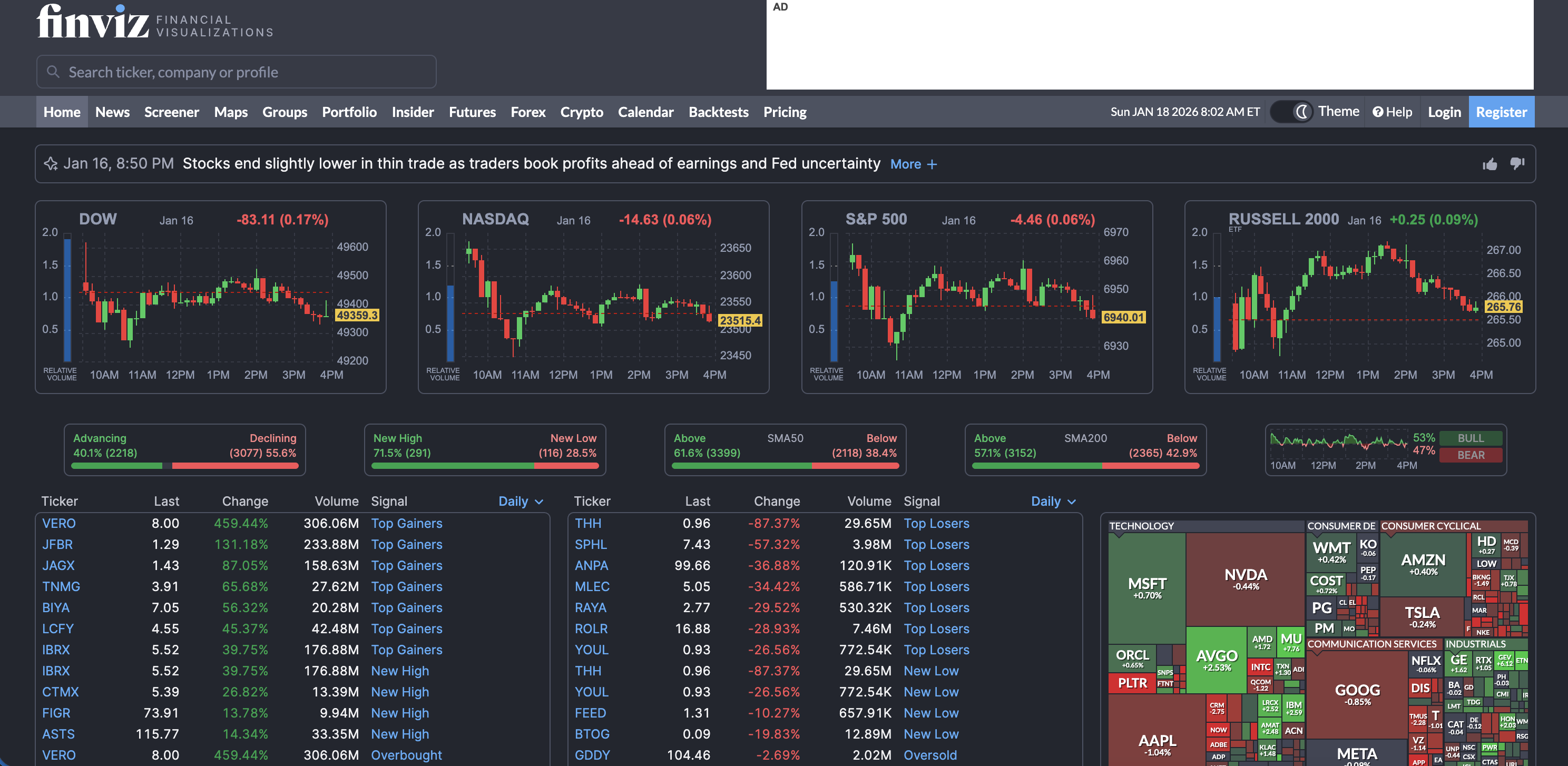
Finviz is a market-visualization and stock-screening platform known for a fast interface, heat maps and compact company snapshots. The free service covers many everyday screening tasks, while Finviz Elite adds real-time data, advanced charts, alerts, exports and backtesting.
Pricing and subscription terms were checked on August 19, 2026. Plan details can change.
Quick Verdict
Finviz
Finviz is one of the most efficient tools for filtering U.S. stocks and scanning market conditions. The free version is useful for research that does not require live quotes. Elite is more appropriate for active users who need real-time data, alerts, exports or backtesting.
Quick Answer
Use the free version if you screen stocks occasionally and can work with delayed data. Consider Elite if real-time quotes, premarket and aftermarket data, alerts, exports or backtesting are part of a repeated workflow.
Core Features
Stock Screener
Finviz lets users filter stocks by descriptive, fundamental and technical criteria. Results update quickly and can be reviewed in tables, charts or snapshot views. The tool is strongest for U.S. equity discovery rather than global multi-asset research.
Heat Maps
The market maps make it easy to compare sectors, industries, company size and price performance. They are useful for orientation, but color and recent price movement do not explain why a security moved or whether the move will continue.
Charts and Technical Views
Free users receive compact charts and technical context. Elite adds real-time and intraday capabilities, advanced charts and more customization. Traders who need extensive drawing tools or community indicators may still prefer a dedicated charting platform.
Backtesting
Elite includes multi-decade backtesting for screening strategies. Backtests are sensitive to the selected period, rules, data quality and assumptions. They are research tools, not forecasts.
Alerts, Export and API Access
Elite adds alerts, data export and API access. These features are useful for users who move screened results into spreadsheets or other research workflows.
Finviz Pricing
Finviz Elite Pricing
Monthly
- All Elite features
- Real-time quotes and charts
- Alerts, exports and API access
- 7-day trial
Annual
- All Elite features
- Equivalent to $24.96 per month
- 7-day trial
- Lower effective monthly cost
💡A credit card is required for the 7-day Elite trial. The selected paid plan starts automatically after the trial unless canceled. Finviz offers refunds during the initial 30-day period upon request.
Free vs Elite
| Feature | Free | Elite |
|---|---|---|
| Stock screener | Yes | Yes, with advanced capabilities |
| Market maps | Yes | Yes |
| Quote timing | Delayed for many U.S. market views | Real-time quotes and charts |
| Premarket and aftermarket data | Limited | Included |
| Backtesting | No | Yes |
| Alerts | Limited | Expanded |
| Export and API access | No | Yes |
| Ads | Yes | No |
Trial and Renewal Details
The Elite trial lasts seven days and requires a credit card. Finviz does not charge during the trial, but the selected subscription begins automatically when the trial ends unless it is canceled. This corrects an older version of this review that incorrectly stated no card was required.
Pros and Cons
Pros
- Fast, practical screening workflow
- Market maps make broad conditions easy to scan
- Free access is sufficient for many casual investors
- Elite combines real-time screening, alerts, backtesting and export
- No software installation is required
Cons
- The free service relies on delayed data for many market views
- The Elite trial requires payment details and converts automatically
- Coverage is more U.S.-equity focused than global research platforms
- Charting is less customizable than specialist charting tools
- Backtests can be overfit if rules are selected after seeing the results
Who Should Use Finviz?
Best For
- Investors who want a quick U.S. stock screener.
- Swing traders who combine technical and fundamental filters.
- Users who prefer visual market maps and compact company pages.
- Active users who can justify Elite's real-time data and workflow tools.
Less Suitable For
- Investors focused primarily on international markets.
- Users who need deep portfolio accounting or detailed fund research.
- Traders who want highly customizable indicators and drawing tools.
Alternatives
TradingView is stronger for charting and custom indicators. Stock Rover offers deeper fundamental and portfolio analysis. Koyfin has broader global research workflows, while Benzinga Pro is more focused on real-time news and alerts. Finviz remains compelling when screening speed and market visualization are the priority.
Final Verdict
Finviz delivers a focused screening experience without forcing every user into a paid plan. The free version is the sensible starting point. Elite is worth considering when delayed data or missing alerts, exports and backtesting create a real workflow limitation.
Explore FinvizFrequently Asked Questions
Does Finviz have a free plan?
Yes. Core screening, maps, news and company views are available without an Elite subscription.
How much is Finviz Elite?
Elite costs $39.50 per month or $299.50 per year.
Does the trial require a credit card?
Yes. A payment method is required, and the selected subscription starts automatically after seven days unless canceled.
Is Finviz real time?
Elite includes real-time quotes and charts. Free market data is delayed in many views.
This review is for general information and does not constitute investment advice. Prices and plan terms can change.
Disclaimer: This article is for informational purposes only and does not constitute financial advice, investment recommendations, or an endorsement of any particular security or strategy. Always conduct your own research and consult with a qualified financial advisor before making investment decisions. Past performance is not indicative of future results.
Written by
John SmithJohn is a financial analyst and investing educator with over 10 years of experience in the markets.